
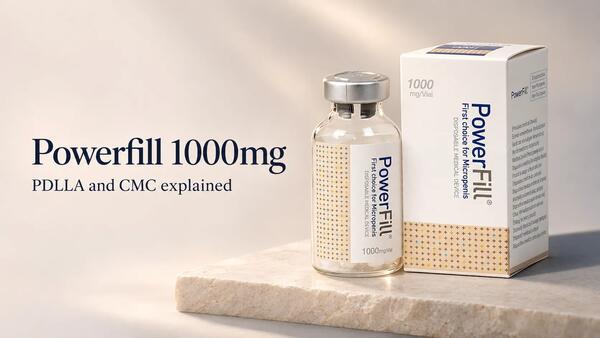
Powerfill 1000mg Explained The Roles of PDLLA and CMC
Powerfill combines a biodegradable synthetic polymer with a water-compatible carrier, supplied in a freeze-dried vial. Those three features explain more about the product than the phrase “collagen booster.” PDLLA is the particulate material associated with the tissue response, carboxymethylcellulose helps the formulation become a usable suspension, and lyophilization describes its dry presentation. They perform different jobs and should not be treated as interchangeable ingredients.
For professionals reviewing Powerfill 1000mg, the useful starting point is therefore its material system. Understanding what each component contributes makes it easier to interpret product descriptions, compare formats, and distinguish early fullness from gradual remodeling. It also prevents a common mistake: assuming that every product described as a collagen stimulator has the same composition, handling characteristics, or supporting research.
What the product name tells you
The 1000 mg designation describes a mass-based vial presentation, not a ready-to-use liquid volume or a measure of collagen that will develop. A REGEN Biotech presentation distributed by Medyglobal describes a 1000 mg vial containing 800 mg of PDLLA and 200 mg of CMC. That makes the distinction between total dry contents and polymer mass particularly important. The current product label remains the reference for the exact supplied presentation. [1]
An ingredient amount cannot be converted directly into an expected contour change. Tissue response, the original condition of the area, and the specific formulation all matter. A larger number on a vial is not a standalone indicator of stronger results, better tissue integration, or suitability for a particular concern.
This is similar to comparing two building materials by shipping weight alone. Weight is useful inventory information, but it does not reveal how the material behaves in its intended application.
PDLLA is the particulate component
PDLLA stands for poly-D,L-lactic acid. It belongs to the polylactic acid family, alongside poly-L-lactic acid, or PLLA. The letters describe different molecular arrangements rather than alternative spellings for one identical material. Chen and colleagues describe PDLLA as amorphous, whereas PLLA has a more ordered, semicrystalline structure. Those differences can influence physical behavior and degradation. [2]
At a practical level, polymer identity helps explain the product category but does not fully define a finished formulation. Manufacturing also determines particle characteristics and the way the particles interact with their surrounding carrier. Two materials can share an abbreviation and still have different physical properties.
Calling PDLLA a collagen stimulator describes the intended biological strategy: introducing a temporary material around which a local tissue response can develop. It does not mean the vial contains collagen, nor does it mean the polymer turns directly into collagen. Collagen is produced by cells; the polymer and the tissue response play different roles.
That distinction keeps the science understandable. The product supplies a material, while the body supplies the biological activity. The final appearance is the result of both, rather than a fixed conversion from milligrams to a predictable amount of new tissue.
CMC has a separate formulation role
CMC means carboxymethylcellulose, commonly supplied as its sodium salt. It is a cellulose derivative that interacts with water and can contribute to viscosity. In a particulate formulation, the surrounding medium matters because particles need to be distributed through a liquid rather than simply present as a dry mass.
A useful analogy is sediment in a glass of water. Merely adding particles to water does not explain how evenly they remain distributed or how the mixture behaves when moved. A carrier changes the environment around those particles. This is a formulation explanation, not a model of what happens clinically.
CMC is therefore not an irrelevant extra and should not be mistaken for a second collagen-producing substance. The comparative composition paper by Chen and colleagues identifies CMC in both of the polylactic acid formulations it discusses, while also showing that their overall compositions differ. Its presence does not make those finished products equivalent. [2]
Why freeze drying matters
Lyophilization, or freeze drying, is a method of removing water from a frozen preparation under reduced pressure. In this context it produces a dry presentation that must be converted into the specified suspension before professional use. A dry vial should not be mentally compared with a prefilled gel syringe as though both contain the same ready-to-use material.
The format creates a useful separation between storage presentation and working presentation. The package contains dry components; the eventual suspension has an additional liquid phase. Consequently, total dry mass and final liquid volume are different measurements with different meanings.
Freeze drying also does not establish a universal shelf life or mean that the product is insensitive to storage conditions. Those are properties of the finished product and packaging, determined through testing. Nor does the word “lyophilized” demonstrate greater clinical potency. It describes the form in which the material is supplied.
Reading the three parts together
| Feature | What it describes | What it does not establish |
| PDLLA | The biodegradable polymer identity | A universal result for all PDLLA brands |
| CMC | A water-interacting carrier component | An independent guarantee of collagen formation |
| Lyophilized form | The dry storage presentation | Superior clinical effectiveness |
| 1000 mg designation | Vial mass presentation | Ready-to-use volume or tissue gained |
The table provides a useful reading method for any technical product description: separate material, carrier, physical form, and quantity before considering performance claims. When those categories are mixed together, a description can sound specific without actually helping the reader understand the formulation.
For example, “large-volume collagen booster” combines a packaging impression with a biological claim. A clearer explanation identifies the dry contents, distinguishes the carrier, and then describes the evidence relevant to the intended outcome. That approach produces a better comparison even when complete head-to-head research is unavailable.
Early appearance and later remodeling are different
The appearance soon after a particulate product is placed is not a direct measurement of new collagen. Liquid, the carrier, and temporary tissue changes can contribute to early fullness. Gradual tissue remodeling is a separate process, evaluated over time rather than inferred from an immediate photograph.
For that reason, comparison photographs are more informative when the time since treatment is stated and the view, posture, lighting, and distance are consistent. A close-up with different shadows may make a surface look smoother without demonstrating a meaningful change in contour.
The same principle applies to written results. “Improved appearance,” “increased volume,” and “more collagen” describe different outcomes. A study measuring one should not automatically be presented as proof of the others. Readers should look for the actual endpoint before interpreting the conclusion.
What PDLLA studies can and cannot tell you
A 2024 randomized multicenter trial by Ting and colleagues compared AestheFill PDLLA with hyaluronic acid for nasolabial fold augmentation. It enrolled 260 participants and followed them for 52 weeks. That is relevant clinical evidence for the studied product and facial indication, but it is not a Powerfill body-contouring trial. [3]
This distinction improves product understanding without dismissing related research. A study can support the plausibility of a material category while leaving questions about another formulation unanswered. Shared polymer chemistry is a starting point for comparison; it is not a substitute for matching the brand, formulation, body area, and measured outcome.
The 2023 RSC Advances review of injectable fillers likewise emphasizes that physicochemical properties and mechanisms differ across filler systems. Its materials perspective is useful for asking better questions, rather than assigning all products a single performance ranking. [4]
Comparing PDLLA with other product descriptions
A cross-linked hyaluronic acid gel is usually discussed in terms of a hydrated gel network and its mechanical properties. A polylactic acid formulation adds the concept of a particulate biodegradable polymer and the tissue response around it. Both descriptions are more helpful than dividing products into “old” and “new” generations.
Within the polylactic acid family, PLLA and PDLLA should remain clearly named. Neither abbreviation proves that one finished product is universally more comfortable, longer lasting, or more effective. Such conclusions require comparisons under defined conditions.
Professionals can organize their reading around three questions: What material is present? What outcome was measured? How closely does that evidence match the product and concern being considered? This framework is especially useful when promotional language is broad but the published studies address a much narrower question.
Frequently asked questions
Does Powerfill contain collagen
No. The formulation discussed here contains PDLLA and CMC rather than injected collagen. The collagen-stimulation concept concerns the body's response to the material. It should not be confused with a collagen implant or a product made from donor-derived connective tissue.
Does 1000 mg mean 1000 mg of PDLLA
Not in the REGEN presentation cited here, which separates the total into PDLLA and CMC. Always distinguish the mass of all dry contents from the amount of the particulate polymer. Neither figure states the final liquid volume.
Is CMC the same as hyaluronic acid
No. They are different polymers with different structures. Both can interact with water, but shared water compatibility does not make them interchangeable. The carrier should be identified as part of the actual formulation rather than inferred from the general product category.
Does freeze drying make a product more effective
Freeze drying describes presentation and processing. Effectiveness must be assessed using product-specific clinical evidence. A powder and a prefilled gel can serve different purposes; their packaging formats alone cannot determine which is preferable for an individual concern.
Can a facial PDLLA study predict body results
It can inform material understanding but cannot establish the same outcome for another brand or body area. Anatomy, baseline concern, formulation, and outcome measures must match closely before numerical results can be applied to a different setting.
Explore the formulation with a clear objective
When reviewing options through FillersFairy, start with the distinction between polymer, carrier, and presentation. Ask for the current product specification and connect it to a clearly defined clinical question. Understanding those three elements makes subsequent comparisons more useful than choosing by vial size or a broad collagen-booster label.
References
1. REGEN Biotech. Introducción a POWERFILL. Product presentation distributed by Medyglobal. 2022.
2. Chen SY, Lin JY, Lin CY. Compositions of injectable poly-D,L-lactic acid and injectable poly-L-lactic acid. Clinical and Experimental Dermatology. 2020;45:347-348.
3. Ting W and colleagues. A Randomized, Evaluator-Blinded, Multicenter Study to Compare Injectable Poly-D,L-Lactic Acid vs Hyaluronic Acid for Nasolabial Fold Augmentation. Aesthetic Surgery Journal. 2024;44:NP898-NP905.
4. RSC Advances. Injectable fillers: current status, physicochemical properties, function mechanism, and perspectives. 2023;13:23841-23858.