
Recent Clinical Trials in the US: What You Need to Know
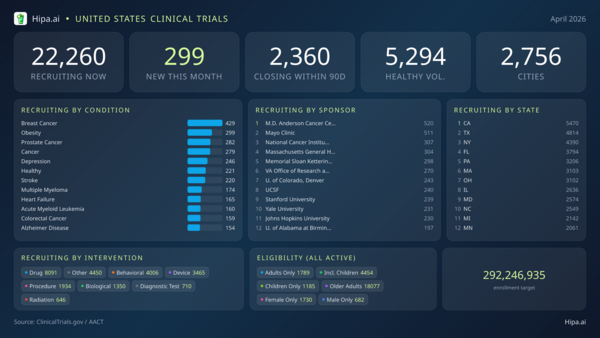
When you hear about a new treatment for a serious illness or a different approach to managing a chronic condition, that treatment didn't just appear overnight. It went through years of rigorous testing. Recent clinical trials in the US are testing hundreds of new approaches to health care right now, from basic allergy medications to complex cancer treatments. If you want to see exactly what is happening in medical research, you can check out Hipa.ai to find all clinical trials and studies currently looking for participants.
Medical testing is a huge part of how doctors figure out what works and what falls flat. Whether researchers are looking for a new way to treat heart disease or trying to understand how sleep affects our immune system, these studies rely entirely on everyday people volunteering their time. Let's look at what researchers are studying right now, how the process works, and what these tests mean for everyday health.
The Push for Better Cancer Treatments
Cancer research gets a massive amount of attention and funding, and for good reason. Almost everyone knows someone affected by the disease. Researchers are moving away from the old standard of simply treating the entire body with harsh chemicals. Instead, they want to figure out how to target the specific cells causing the problem.
Immunotherapy Updates
Your immune system is incredibly smart, but cancer cells are sneaky. They know how to hide from the cells that are supposed to destroy them. Right now, dozens of US studies are testing new ways to unmask cancer cells. Doctors take a patient's own immune cells, train them in a lab to recognize the specific cancer they are fighting, and then put them back into the body. This approach has shown amazing promise for certain blood cancers, and current testing is trying to see if it can work just as well for solid tumors like breast or lung cancer.
Precision Medicine
Doctors used to treat all breast cancers or all lung cancers roughly the same way. Now, they look at the genetics of the tumor itself. Current studies are testing drugs designed to block the exact genetic mutation causing the tumor to grow. If a patient has a specific genetic marker, they might qualify for a test drug that ignores healthy cells and only attacks the sick ones. This usually means fewer side effects and better results for the patient.
Tackling Neurological Conditions
The brain is still one of the biggest mysteries in medicine. Conditions that affect memory, movement, and cognition take a massive toll on families, and finding treatments has proven incredibly difficult.
Progress in Alzheimer’s Research
For decades, Alzheimer’s treatments focused entirely on managing symptoms. Now, testing is shifting toward slowing down the disease itself. Researchers are running trials on medications that clear out sticky plaques in the brain that seem to cause memory loss.
Recent studies are focusing on:
- Early detection methods, like specialized blood tests, to catch the disease before symptoms appear.
- Lifestyle interventions, combining diet, exercise, and brain training to see if they delay onset.
- Medications that target brain inflammation, which doctors now suspect plays a massive role in cognitive decline.
Moving Forward with Parkinson’s Disease
Parkinson's testing is also seeing a shift. Doctors are looking at new ways to deliver dopamine directly to the brain, using tiny pumps instead of pills that wear off quickly. They are also testing gene therapies that might stop the brain cells from breaking down in the first place.
Weight Management and Metabolic Health
If you pay attention to health news, you have probably noticed a massive shift in how doctors treat weight loss. The conversation has completely changed over the last two years, mostly due to new medications that treat obesity as a metabolic condition rather than a simple lack of willpower.
The GLP-1 Receptor Agonists
Drugs originally created to help people manage Type 2 diabetes turned out to have a massive impact on appetite and weight. Now, clinical testing is expanding fast. Researchers want to know what else these medications can do.
Current testing is looking at:
- Whether these weight loss drugs can actually lower the risk of heart attacks and strokes.
- How they affect conditions like sleep apnea and fatty liver disease.
- If they might help treat addiction, since the drugs seem to quiet the "food noise" and cravings in the brain.
Mental Health and Alternative Therapies
Mental health treatments stayed exactly the same for a very long time. Doctors prescribed standard antidepressants, suggested therapy, and hoped for the best. That standard approach works for many people, but millions of others never find relief. Researchers are finally running large-scale tests on completely different approaches.
Psychedelic-Assisted Therapy
This is perhaps the biggest shift in psychiatric testing in half a century. Universities across the US are running strict, heavily monitored trials using substances like psilocybin and MDMA to treat severe depression, PTSD, and severe anxiety. The results so far show that when paired with intensive therapy, these treatments can help the brain rewire itself and break out of deeply entrenched negative thought patterns.
Heart Health and Cardiovascular Studies
Heart disease remains a massive health issue in the United States. Researchers are always looking for better ways to keep blood pressure down, clear out arteries, and strengthen the heart muscle after a heart attack. Recent testing involves mRNA technology. We all heard about mRNA during the pandemic, but researchers have been working on it for decades. Right now, they are testing mRNA vaccines that could actually teach the body to lower its own bad cholesterol. If these tests succeed, it could mean taking one shot every few months instead of taking a daily pill to manage cholesterol levels.
Other heart studies are focusing on wearable technology. Doctors are testing whether smartwatches and wearable heart monitors can detect irregular heartbeats early enough to prevent strokes.
Rare Diseases and Gene Editing
When a disease affects only a few hundred or a few thousand people, it rarely gets massive funding. But the technology behind gene editing is changing how doctors approach these rare conditions.
CRISPR technology acts like a pair of genetic scissors. It allows scientists to cut out a broken piece of DNA and replace it with a healthy sequence. US researchers are currently testing this on conditions like sickle cell disease. By fixing the genetic code in the patient's stem cells, doctors are aiming for a one-time cure rather than a lifetime of symptom management.
How the Testing Process Actually Works
You might wonder how a new idea in a lab actually becomes a medicine you can pick up at the pharmacy. The process takes years and happens in very specific phases to make sure everything is as safe as possible.
Phase 1: Is it safe?
The very first time a new treatment goes to humans, the study group is tiny. Usually, it involves just 20 to 80 healthy volunteers. The doctors are not even checking to see if the drug cures the disease yet. They just want to know if it is safe, what the side effects are, and how the body breaks it down.
Phase 2: Does it work?
If the treatment proves safe, it moves to the next group. This time, doctors give the treatment to a few hundred people who actually have the condition they want to treat. They want to see if the drug does what it is supposed to do and figure out the exact right dose.
Phase 3: Is it better than what we already have?
This is the big one. Phase 3 involves thousands of people across different clinics and hospitals. Half the people get the new treatment, and the other half get the current standard treatment (or a placebo, if no treatment exists). Doctors compare the two groups over a long period. If the new drug works better or has fewer side effects, the drug company can ask the government for permission to sell it.
Phase 4: Long-term tracking
Even after a drug hits the market, the testing does not completely stop. Doctors keep tracking patients to make sure no weird, long-term side effects pop up after years of use.
What to Expect If You Volunteer
People volunteer for medical testing for plenty of reasons. Some have a condition that current medicines cannot fix. Others just want to help push science forward. If you decide to join a study, you have specific rights and protections.
Before anything happens, you will go through a process called informed consent. This is not just a form you sign. The research team must sit down with you and explain:
- Exactly what the study is trying to prove.
- Every single test, blood draw, or scan you will have to undergo.
- All the known risks and potential side effects of the treatment.
- The fact that you might get a placebo instead of the real drug.
You can also walk away at any time. If you join a study and decide a week later that you hate it, you can simply quit. Nobody can force you to stay in a trial.
Diversity in Medical Testing
One massive problem in older medical testing was a lack of diversity. For a long time, most test subjects were young, white men. But a blood pressure pill might work differently in a 60-year-old Asian woman than it does in a 30-year-old white man.
Right now, US researchers are pushing hard to make sure their test groups look like the actual population. They are bringing testing centers into different neighborhoods, offering transportation to clinics, and making sure their instructions are available in multiple languages. Better diversity in testing means the final drugs are safer and more effective for everyone.
Looking Ahead: What Clinical Trials Mean for the Future
Medicine moves slowly, but every single treatment we rely on today started as an idea in a lab. The asthma inhaler you keep in your bag, the antibiotic you take for a sinus infection, the pain reliever you grab for a headache all of them went through these exact same steps.
The recent push in areas like gene editing, targeted cancer therapies, and metabolic health shows that doctors are looking for actual cures instead of just Band-Aids. They want to fix the root cause of the problem. That shift in thinking requires massive amounts of testing and thousands of willing volunteers.
If you want to keep an eye on what is happening right now, or if you or a loved one are looking for a new treatment option, you can always search for studies near you. Finding the right trial used to mean asking your doctor and hoping they knew someone running a study. Today, the information is entirely public and easy to search if you know where to look. By taking a few minutes to explore what researchers are working on, you get a front-row seat to the future of medicine.