
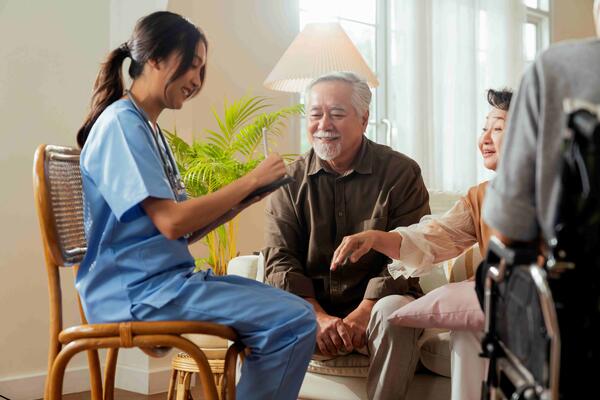
The Human Side of Elder Care: Why Nursing Soft Skills Matter as Much as Clinical Training
Nurses deal with maladies all day long. It’s arguably their job description, but there is an entire soft set of skills that are equally important and arguably more impactful in terms of patient experience.
This is uniquely true in the case of elder care. In this article, we take an in-depth look at how soft skills are at least just as important as technical ones when it comes to caring for the aging population.
Gerontology Care Explained
Before we get into too much detail about the skills required to take care of aging patients, it’s important to qualify what we’re describing. To be an aging patient is not necessarily to have reached a specific age, but rather to have developed a certain physical condition.
Gerontology care, in particular, refers to people who are of a certain age and in a position where they are not likely to substantially improve. A good example is Alzheimer’s. You’re not dying, exactly, at least not anytime soon, but you are not going to fully recover either.
The purpose of gerontology care is generally to maximize the quality of life. Because the circumstances are so severe, the considerations are a little different. Being compassionate and kind is enormously useful when dealing with patients who have almost nothing in the way of hope.
Note that not all elder care is in this context. Wellness nurses, for example, get to work on the proactive side of senior care. Their job is to help aging members of the population develop strategies that will maintain their health and maximize longevity.
Why Soft Skills Matter
None of what we’re about to say is to suggest in any way that clinical ability is unimportant in elder care. Rather, it’s an assumed part of the job description. If you’ve gotten through nursing school and passed the NCLEX, you already have the required clinical ability to be a good nurse. It’s less sure that you’ve developed soft skills adequately.
Most nurses have some base level of compassion that draws them into the profession. They also learn on the job how to interact with patients. But soft skills themselves can be elusive. It’s difficult to define what they are, even, let alone to quantify success.
In the next few headings, we take a look at what skills are of particular importance when dealing with aging members of the population, and how you can develop those skills as a nurse practicing gerontology.
Communication
Communication is one of the most important skills in healthcare. It’s how you acquire information from patients. It’s also how you pass it along. Possibly of equal importance, though, it’s also how you make people feel when you communicate with them.
A person with truly strong communication skills will make it so that the other person always knows they’re being heard. You can signal this through a combination of physical and auditory clues. Nodding your head as the other person speaks is a great way to signal your ongoing interest, while repeating things that the person has said is a great way to ensure that they know you’re actively listening.
Passing along information in a way that is useful and impactful is also important. It’s just something you get good at with practice. One of the complicated things about being a nurse is that you have lots of technical understanding, but you need to communicate it in a way that is accessible to someone who might have none at all. That’s a skill that takes time to develop, but it’s absolutely learnable.
Compassion
Compassion is an important element of healthcare, but it’s also one that can’t really be quantified. How do you increase your compassion? Maybe more importantly, how do you communicate your compassion to the person you’re feeling empathy for?
There’s no one-size-fits-all answer to either one of these questions. However, it does help to practice some of the communication skills we described in an earlier heading. People will generally feel more cared for when they get the sense that you’re actively engaged with them as a person.
This is particularly impactful for aging members of the population because, in many cases, they simply don’t have another person they can depend on for sympathy or connection.
Just making a point of asking a person about their day, their interests, their beliefs, their priorities, and so on, can be a good way to make someone feel better about their treatment.
Emotional Resiliency
Emotional resiliency is of particular importance with aging populations because you’re typically dealing with patients who will only decline. That regression may happen slowly, but by virtue of the service category itself, it will almost inevitably take place.
Pretty much every nurse experiences sad things from time to time, but nurses who work with the elderly experience it almost as the exclusive reality for gerontology nurses.
Emotional resiliency is important in that it will help you stay on the job, but it will also instill higher levels of confidence in the patient. They don’t want someone hovering over them with a mournful expression on their face. They want a confident care provider who will demonstrate compassion without making them feel conspicuous.
Conclusion
What does it take to be a great nurse? It’s a combination of clinical ability and soft skills. The clinical ability you’ll have on day one. The soft skills? You’ll probably have some of them by the time you graduate college. Others you’ll develop with effort.
You don’t have to have everything exactly right from the get-go. Nurses are just like any other professional—they develop their skills slowly and through experience.
Here’s the good news: it’s most likely compassion and a desire to help others that brought you to the profession in the first place. These base personality traits will go a long way toward helping you provide the level of support that your patients deserve and desire.