
5 Holistic Therapies That Complement Memory Care for Seniors with Dementia
More than 55 million people worldwide are living with dementia. By 2050, that number is expected to triple, according to the World Health Organization.
For families navigating this reality, the search for day-to-day relief often goes beyond medication. Holistic therapies are growing powerful complements, not a replacement, to conventional memory care for seniors.
These remedies don’t need a prescription, but they should always be used responsibly. It is recommended that you seek the approval of your aging family member’s doctor before trying any therapy, including aromatherapy.
1) Music Therapy
Music memory is one of the last to fade. Long-term musical memories are stored in the medial prefrontal cortex. That's why a person who struggles to recall a grandchild's name can still sing every word of a song they loved at 20.
A Cochrane Review found that music therapy significantly reduced agitation and anxiety in people with dementia, with effects lasting beyond individual sessions. According to the Alzheimer's Association, music therapy is endorsed as a non-pharmacological tool for managing distress during personal care routines.
There are two main types used in memory care for seniors:
- Active Music Therapy — singing, clapping, or playing simple instruments alongside a trained therapist
- Receptive Music Therapy — listening to carefully chosen music in a one-on-one or small group setting
How caregivers can start music therapy at home:
- Build era-specific playlists. Focus on music from ages 15–25, when emotional musical memories form the strongest.
- Use it during difficult moments. Familiar music during bathing or dressing can significantly reduce resistance and anxiety.
- Observe their response. Tapping feet or relaxed shoulders signal it's working. Agitation means trying a different era.
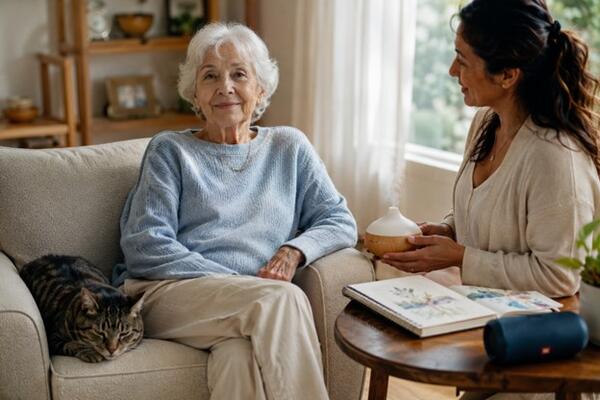
2) Aromatherapy
The smell center is linked to the part of the brain that controls emotions and memory.
As reported by a study published in the Journal of Alternative and Complementary Medicine, treatment of dementia patients with lavender aromatherapy had the effect of decreasing their agitated behavior. Lemon balm has also produced positive results in decreasing agitation in patients.
Diffusion, aromatherapy massage, or applying the substance on the skin diluted in a carrier oil are common ways to administer the remedy. Direct application of essential oils should never be done. Eucalyptus essential oil, especially, is known to be a respiratory sensitizer.
Whether through a local wellness shop or a weed delivery lincoln service, caregivers have more ways than ever to source products. Providers of holistic wellness products for seniors can help identify senior-appropriate formulations.
3) Art Therapy
Creativity utilizes networks in the brain that remain engaged long after the capacity to communicate verbally is lost. Art therapy uses procedural memory, which remembers “how to” skills. This form of memory remains intact even later in dementia compared to others.
Professional art therapy is conducted by a trained therapist, but structured creativity at home is still valuable. Painting, collage, and modeling clay are just some of the activities that can be therapeutic without the aid of a therapist.
At-home art therapy tips:
- Use simple supplies: large-bristled brushes, washable paints, and heavy paper
- Offer choice without pressure — "Would you like to paint or draw?" reduces decision fatigue
- Focus on process, not outcome. Resist the urge to correct their work
- Establish a regular time for creativity to establish routines and cut down stress
- Choose topics that are already known to the person: family pictures, nature, food
- Keep sessions short; 15 to 20 minutes is plenty for most dementia stages
- Play soft background music during sessions to help with focus and relaxation
4) Gentle Movement (i.e., Tai Chi)
Regular physical activity, even gentle forms, can slow cognitive decline and improve mood in older adults with dementia.
Tai Chi pairs slow, deliberate movement with rhythmic breathing, making it well-suited for seniors at various stages. It supports balance and coordination while offering a calming, meditative quality that can reduce anxiety — and is one of the most effective tools for ongoing fall prevention in older adults with dementia.
Chair yoga can be used by people during their advanced stages, as it involves stretches and breathing exercises performed sitting down.
5) Animal-Assisted Therapy
Animals don't require verbal communication. They're non-judgmental and create natural opportunities for physical contact, which matters deeply for people who feel isolated by cognitive decline.
Similar benefits can be derived from having companion pets at home, but a few things need to be considered:
- Assess allergies and hygiene needs before getting a pet
- Supervision matters, as dementia can affect judgment around animals
- It is recommended to have calm and more docile animals, such as older dogs and indoor cats
- Regular interaction with a pet can reduce agitation and improve mood throughout the day
- Caring for an animal, even in small ways, gives seniors a sense of purpose and routine
Where live animals aren't feasible, robotic pet alternatives have shown reductions in agitation and loneliness in clinical settings.
How to Introduce Holistic Therapies to a Memory Care Team
Memory care professionals aren't always opposed to complementary therapies, but they need to know what you're doing. Approaching the care team thoughtfully protects your loved one and builds the trust that makes coordination possible. Knowing what questions to ask about mental health care before committing to a senior living community can make that process significantly smoother.
- Frame it as complementary. Make clear you're not looking to replace medication or the existing care plan.
- Come with research. Print a key study summary. Cochrane or NIH sources carry weight with clinical staff.
- Ask what's already in place. Many facilities already offer music, art, or movement programming you can build on.
- Track outcomes. Did agitation decrease after a music session? Simple notes build credibility over time.
- Disclose everything used at home. Essential oils, herbal supplements, and hemp-derived products all need to be on the care team's radar.
Frequently Asked Questions
Are holistic therapies safe for seniors with dementia?
Most are relatively harmless if used carefully. However, aromatherapy should be used with extra care since essential oils can only be applied diluted and not in contact with the skin. If your senior is on medication, please consult their doctor first.
Can holistic therapies replace medication for dementia?
No. These therapies work alongside medical treatment, not instead of it. Adjusting or discontinuing medication is a decision that must involve a physician.
What holistic therapy is best for late-stage dementia?
Music therapy and animal-assisted therapy are both available in end-stage dementia cases since these forms of therapy do not require verbalization. Music that one recognizes can evoke emotion despite significant impairment in verbalization.
How do I find holistic memory care options near me?
Start by asking your loved one's memory care facility about integrated wellness programming, as many already offer it. Families evaluating providers can also find guidance on comparing home care services that include holistic and integrative care approaches. A local Alzheimer's Association chapter can also connect families with vetted resources and programs in their area.
How often should holistic therapies be introduced?
There is no one-size-fits-all answer. Start with one therapy at a time, a few sessions per week, and observe how your loved one responds before adding more.
Conclusion
There is no one treatment option to reverse dementia. However, each of the five strategies presented has an evidence-based reason for contributing positively to the quality of daily life for those with the disease.
Music therapy ensures that the emotional connection remains despite the loss of other memories. Aromatherapy provides a simple sensory strategy to achieve a sense of calm. Art therapy ensures that there is a way to communicate even if speech becomes difficult. Lastly, Tai Chi and chair yoga are exercises that keep the person active without the high risk of falls.
The challenge is not to seek one definitive solution but rather to develop a holistic approach that you know your loved one's care providers are aware of and that fits his or her stage of dementia.
Disclaimer: This article is for educational purposes only and does not constitute medical advice. Always consult a qualified physician or geriatric specialist before introducing any new therapy into a dementia care plan.